Posts

Showing posts with the label ROBOTS

RESEARCHERS DESIGN SOFT ROBOTS THAT CAN MOVE ON THEIR OWN

Image
If Star Wars' R2-D2 is your idea of a robot, think again. Researchers led by a University of Houston engineer have reported a new class of soft robot, composed of ultrathin sensing, actuating electronics and temperature-sensitive artificial muscle that can adapt to the environment and crawl, similar to the movement of an inchworm or caterpillar. Cunjiang Yu, Bill D. Cook Assistant Professor of mechanical engineering, said potential applications range from surgery and rehabilitation to search and rescue in natural disasters or on the battlefield. Because the robot body changes shape in response to its surroundings, it can slip through narrow crevices to search for survivors in the rubble left by an earthquake or bombing, he said. Soft robot can move on its own . Credit: Image courtesy of University of Houston "They sense the change in environment and adapt to slip through," he said. These soft robots, made of soft artificial muscle and ultrathin deform...

AMAZING ROBOTS ASSEMBLED FURNITURE IN 20 MINUTE

Image
This is amazing stuff happened in Singapore recently, within 20 minutes these pair of robot assembled this furniture. Technology improves daily, and also the comfort of humans. The task in question is assembling IKEA furniture, and scientists at Nanyang Technological University have developed algorithms that enable the robots to take the necessary steps to assemble IKEA’s Stefan chair. The actual assembly phase took 8 minutes and 55 seconds. Prior to the assembly, the robot took 11 minutes and 21 seconds to plan the motion pathways and three seconds to locate the parts. watch video Asst Prof Pham Quang Cuong ,  from NTU’s School of Mechanical and Aerospace Engineering said: “For a robot, putting together an IKEA chair with such precision is more complex than it looks. “The job of assembly, which may come naturally to humans, has to be broken down into different steps, such as identifying where the different chair parts are, the force required to grip the part...
Image
Apple has a new iPhone recycling robot that can take apart 200 iPhones in an hour. Called  Daisy,  the machine lets Apple recover materials from the phone traditional methods of recycling can't. Daisy can take apart nine different iPhone models from iPhone 5s to iPhone 7 Plus.  Apple introduced Daisy as part of a range of environmentally conscious decisions ahead of World Earth Day. Daisy was created from the same technology and even parts of Apple’s previous phone recycling robot, Liam. The first operational Daisy is located in Austin, a second Daisy will soon be located in the Netherlands. Apple hopes to expand the iPhone recycling initiative, they reportedly have plans to patent Daisy as well. Daisy is capable of disassembling and retrieving an iPhone's main logic board, speaker, and rear camera, among other components that contain high-quality materials.    At Apple, we’re constantly working toward smart solutions to address climate chang...

SIX LEGGED ROBOT GETS CLOSER TO NATURE

Image
A study led by researchers at Tokyo Institute of Technology (Tokyo Tech) has uncovered new ways of driving multi-legged robots by means of a two-level controller. The proposed controller uses a network of so-called non-linear oscillators that enables the generation of diverse gaits and postures, which are specified by only a few high-level parameters. The study inspires new research into how multi-legged robots can be controlled, including in the future using brain-computer interfaces. In the natural world, many species can walk over slopes and irregular surfaces, reaching places inaccessible even to the most advanced rover robots. It remains a mystery how complex movements are handled so seamlessly by even the tiniest creatures. What we do know is that even the simplest brains contain  pattern-generator circuits (CPGs) 1 , which are wired up specifically for generating walking patterns. Attempts to replicate such circuits artificially have so far had limited success, d...

JUST IN: SELF-DRIVING AIRSIDE VEHICLE INVENTED BY OXOBOTIC

Image
London's largest airport Heathrow is investing in autonomous vehicles for their fleet of transport vehicles. The airport recently announced that it finished primary trials of self-driving airside vehicles.  The idea comes from a partnership with cargo specialist  IAG Cargo  and a United Kingdom-based startup called  Oxbotica . Oxbotica makes a particular software that allows vehicles to operate in a self-driving mode without using GPS or any other technology beyond what it has in the vehicle. The “CargoPod” vehicle, designed by Oxbotica, spent three and half weeks running autonomously along a cargo route around the airside perimeter. The trial collected over 200km of data that will enable IAG and Heathrow to assess potential opportunities for the use of autonomous vehicles in airport environments of the future. Technology is evolving at an incredible pace. We are working with fantastic businesses like Oxbotica to develop new capabilities that will change...

Robots now coexist with children

Image
Study shows that children tends to coexist with robots that possesses human likeness against human appearance but remain distinguished from humans. Robots are physically and socially attractive when they possesses social attribute.  Robots with moderate anthromorpohic le vel and social cues can enhance child preference and acceptance of robots. The truth is that AI and robotics is a double-edged sword: the more that we create intelligent beings who are imbued with human characteristics, capabilities and behavior, the better we perceive them as humans though the threatens the labour force. At the annual ACM/IEEE International Conference on Human Robot Interaction (HRI), a team from South Korea unveiled Shelly – a robot that teaches children empathy. The team presented their work at this year’s ACM/IEEE International  Conference on Human Robot Interaction (HRI) , which was held earlier this month in Chicago The shell is equipped with LEDs to entice the childr...

ROBOTIC FISH makes discovery safer underwater

Image
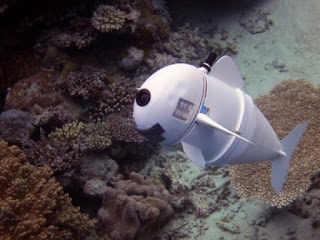
The 21st century scientists are working extremely hard to make life easier for humans.  The invention of domestic and industrial robots and other devices makes the work done efficient,  though it threatens welfare of humans. Scientists have developed robotic fish to help researchers do underwater research. The robo-fish can swim alongside real fish to give new perception into life below. The robotic fish named SoFi was developed by MIT's Computer Science and Artificial Intelligence Laboratory (CSAIL), can be controlled with sound. SoFi swims by flapping its hydraulic-pump powered tail back and forth.  The clever robot can also control its own buoyancy through adjusting an internal foam material. During test dives in the Rainbow Reef in Fiji, SoFi was able to swim down 15 meters for more than 0 minutes at a time. It could navigate and respond to current and avoid collision with coral. During the swim, SoFi collected data by taking photos and videos u...