Posts

THE BASICS OF THE COMPRESSION IGNITION ENGINE
Image
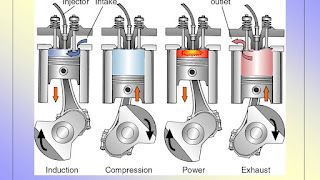
The compression ignition engine[C.I engines] also known as the diesel engine is invented by Dr. Rodolph Diesel. The C.I engine is an internal combustion engine in which combustion occurs as a result of the compression of the air to a temperature sufficient enough to ignite the fuel. There are several similarities and minor difference between the C.I engines and the gasoline powered engines(spark ignition engines,S.I engines). The components such as the crankshaft, camshaft, piston,valves etc they both share in common.  The same cycle of operation governs both for the four stroke and two stroke engine process. However the diesel engines can easily be recognized by the absence of the ignition system and other factors such as Injection of fuel is done via an injection pump They are noisy and produces pollutants easily It produces more power and torque Overtime, diesel engines have received massive success in the construction of heavy duty trucks,construction equipment ,powe...
THE FUNDAMENTALS OF THE TWO STROKE CYCLE ENGINE

Image
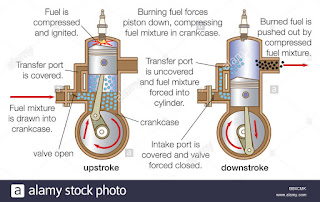
There are uncertainty about the longevity of the two stroke cycle engine as compared to other cycle of operation .Knowledge of Its importance and principles of operation will help justify the strength of the two stroke cycle engine as compared to others.  Internal combustion engine dated back to 1876 when Dr. Nicolaus A. Otto first invented the spark ignition engine[petrol], then Rudolf Christain Karl Diesel developed the compression ignition engine[Diesel]. Since then engines have continue to develop with new technologies as well as increase in the knowledge of engine process. The purpose of the internal combustion engine is the production of mechanical power from chemical energy contained in fuel. The energy is released by burning the fuel inside the engine.  According to the cycle of operation,engines are classified as the two stroke cycle,four stroke cycle six stroke cycle and the rotary combustion. The rise in global technology which increased the demand of new typ...

THE LUBRICATION BASICS

Image
Machines tends to fail or work below its required strength or capacity  due to improper lubrication of the machine components. Many operators ignores the fact that friction exist thereby underestimating the importance of lubrication. Some do not know what lubrication means, its principle,the positives and negatives and why its necessary for it to be in check. The techniques of using lubricants to reduce friction between surfaces is termed lubrication. This definition contains two main terms, lubricant and friction. Understanding what friction is, will help us in the application of lubricants.  Friction is that which hinders a body from moving smoothly on the surface of another, a stationery and a moving part or two or moving parts. Friction has a role to play in machines but when it becomes excessive or when its not needed,  damage will occur in the machine or its component. Effects like corrosion, overheating, wear and others have the possibility of occurring if...

THE TURBOCHARGER SERIES

Image
The value of the turbo charger in an automobile is unknown to a few engineers and its users, because they lack the proper knowledge on these points of the component itself. http://d3e98kcom2u4ch.cloudfront.net/wp-content/uploads/oldblog/2016/09/turbocharger-operation-diagram.jpg What is the value of the turbocharger? What is it made of? How does it work? Where can it applied? Likely problem encountered Ignorantly we think the main reason motor A generates more power,higher velocity,consumes less fuel, sometimes environmental friendly than motor B is because of the engine structure or size. But there is one way to improve an engine which is the turbocharger. The turbocharger is an exhaust-gas driven component of an engine that increases the volumetric efficiency of air in an engine in order to increase its power.  It consist of a casing,impellers and shaft. Generally, the charge[mixture of fuel and air] that flows into the combustion chamber produces the t...

LATE PROFESSOR STEPHEN HAWKINGS FINAL THEORY ON THE ORIGIN OF THE UNIVERSE HAS BEEN PUBLISHED BY PROFESSOR THOMAS HERTOG

Image
biography.com The late professor  Stephen Hawking's  final theory on the origin of the universe has been published today in the  Journal of High Energy Physics . Hawking collaborated with Professor Thomas Hertog from KU Leuven on the paper which was submitted for publishing before  Hawking's death  in March this year. The paper’s ideas are based on string theory, it predicts the universe is finite and that the universe's origin may, in fact, be far more simple than current theories relating to the Big Bang. Modern Big Bang theorists believe that the universe came into existence with a burst of inflation that started to occur just moments after the Big Bang itself. It is thought that once this inflation begins the quantum effects can keep it going indefinitely. The part of the universe that we can observe is just a hospitable pocket where inflation has ended. "The usual theory of eternal inflation predicts that globally our universe is like...

16 EARLY INNOVATIONS THAT BIRTH THE MECHANICS OF TODAY

Image
Mechanical engineering  is a very wide discipline that, effectively, covers anything that moves.  Its breadth is due, in part, from its need to cover the design and manufacture of anything and everything in a moving system. This ranges from a system's smallest components to the completed, sometimes enormous, machine as a whole. Throughout history some  innovations  have come to define mechanics as we know it today, the following are no exception. These engineering innovations range from the any one of the classical 'simple machine' to complex concepts such as  flight . This list is far from exhaustive and in no particular order. 1. The Aeolipile Was an Early Steam Reaction Turbine The  Aeolipile   was the world's first rotating steam engine or more technically correct, a steam reaction turbine. It was devised by the great Heron of Alexandria in the  1st Century AD  and described it in great detail in his book  Pneumatica . ...